The MCP Protocol
Senso MCP is built on the MCP protocol. Understanding its principles helps you appreciate what the solution brings to your Joomla site — and why it is interoperable with a wide range of assistants.
Model Context Protocol at a glance
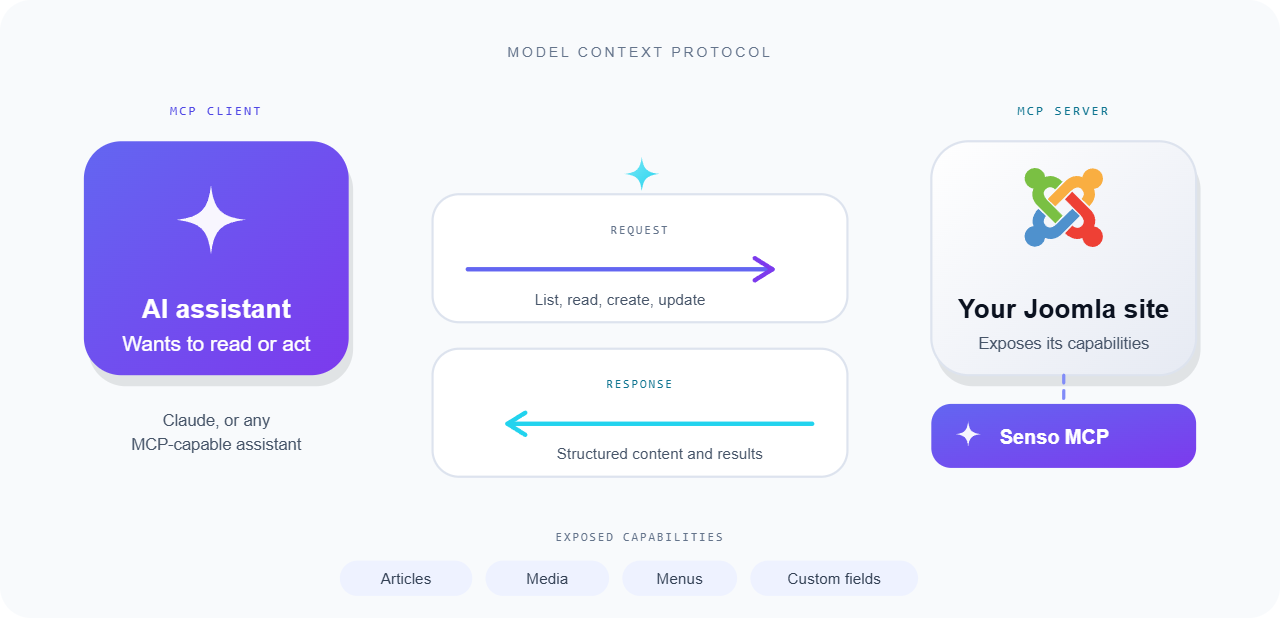
The Model Context Protocol (MCP) is an open standard that describes how an AI assistant connects to an application to access data and perform actions. It can be thought of as a “universal connector” between artificial intelligence and your software.
Rather than building a bespoke integration for each application, MCP defines a common language: any application that exposes an MCP server can be operated by any compatible assistant.
Clients & servers
The protocol distinguishes between two roles:
- the client — the AI assistant (for example, Claude) that wants to read data or perform actions;
- the server — the application that exposes its capabilities.
Senso MCP is the component that turns your Joomla site into an MCP server: it exposes Joomla’s functions and responds to requests from the client.
Tools & scopes
An MCP server exposes its capabilities as tools: individual actions such as “create an article” or “list the menus”. The assistant selects the right tool for your request and calls it with the appropriate parameters.
Scopes define the authorised access when connecting: they set out what the client is allowed to do, in line with your Joomla permissions.
Why MCP for Joomla
Using MCP with Joomla means:
- interoperability — a single server that can be used by any MCP client;
- simplicity — no application-specific integration to develop;
- security — access restricted by authentication and your access permissions.